
A prosthetic limb isn't a single purchase. It's a recurring one, replaced every few years for the rest of a person's life as components wear out, technology changes, and fitting requirements change with it. That reality is exactly why an amputation claim can't be built around a single payment the way a broken arm or a minor collision claim often can.
Hale Law works with people across Sarasota, Bradenton, and the surrounding Gulf Coast, adjusting to life after losing a limb in a crash, and the questions that come up early are rarely just about the crash itself. They're about what comes next, for years, and how a claim needs to account for that entire stretch of time rather than just the first few months of treatment.
Key Takeaways
- An amputation claim generally has to account for a lifetime of prosthetic replacement, not a single device.
- Florida's PIP coverage pays medical costs up to $10,000 first, and amputation-related treatment typically exceeds that almost immediately.
- Amputation injuries generally meet Florida's serious injury threshold without much dispute from insurers.
- Comparative negligence can still reduce or eliminate recovery regardless of how severe the injury is.
- Device category, level of amputation, and activity level all affect what a prosthetic costs and how often it is replaced.
- Florida's two-year filing deadline applies to amputation claims the same as any other negligence case.
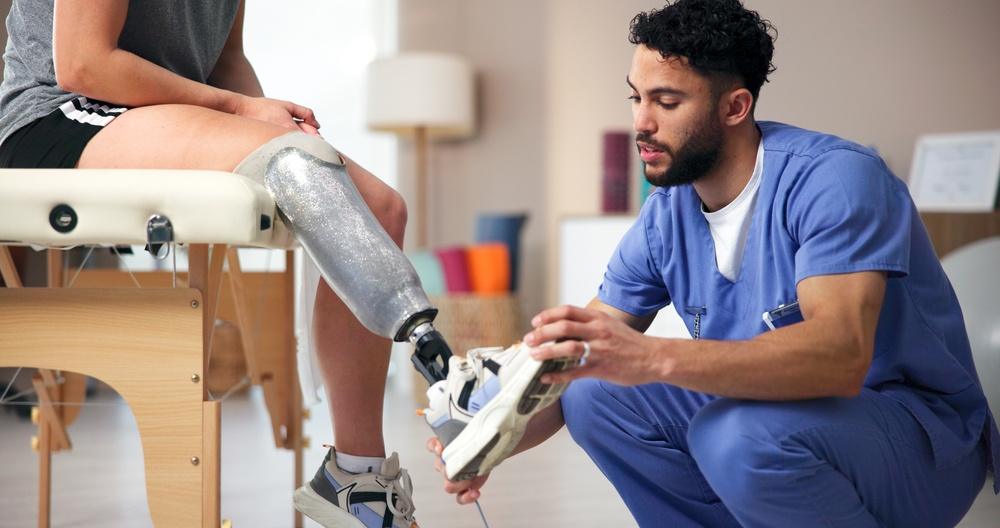
Why an Amputation Claim Rarely Resolves Around a Single Payment
A prosthetic device has a working lifespan measured in a few years rather than decades, before wear and changing fit requirements make replacement or a significant refit necessary. A claim that only accounts for the first device misses every replacement that follows it, along with the fittings, adjustments, and rehabilitation costs that come with each one.
That ongoing need is part of what separates an amputation claim from most other injury claims. The cost picture doesn't close out once initial treatment ends, because the first device is rarely the one a person keeps, and every device that follows carries its own fitting and adjustment expense.
Insurers evaluating these claims sometimes focus heavily on the immediate medical bills, since those are easiest to document and verify. A claim built only around what's already been spent tends to undervalue everything that hasn't happened yet, which, for an amputation, is most of the actual cost.
Does Florida's No-Fault Insurance Cover Amputation Injuries?
Yes, at least at the start. Florida requires Personal Injury Protection (PIP) on every registered vehicle, and under Florida Statute 627.736, that coverage pays medical bills first, up to a statutory minimum of $10,000, regardless of who caused the crash.
For an amputation, that limit rarely stretches far. Emergency care and hospitalization alone can exceed $10,000 before a patient leaves the hospital, let alone reaches the point of being fitted for a prosthetic device.
Because amputation involves the permanent loss of a limb, it generally meets Florida's serious injury threshold under Florida Statute 627.737 without the kind of dispute that surrounds claims involving less visible injuries. That threshold question, which dominates so many other injury claims, tends to move out of the way quickly here, shifting the focus toward how the injury will affect the person's life for decades to come.
Once PIP is exhausted, health insurance typically becomes the next payer for ongoing treatment, including the prosthetic fitting process itself. Some prosthetics clinics work under a payment arrangement tied to an eventual settlement, similar to how other medical providers sometimes handle catastrophic injury cases, which can ease the immediate financial pressure while a claim is still being built.
How Comparative Negligence Can Still Reduce an Amputation Claim
Severity doesn't change how fault gets calculated. Florida Statute 768.81 reduces a recovery by the injured person's percentage of fault and bars recovery entirely once that share is greater than 50 percent.
Motorcycle crashes, a common cause of traumatic amputation, often draw fault arguments around lane position, speed, or visibility. Those same arguments come up in truck crashes and pedestrian incidents, where multiple accounts of what happened can complicate an otherwise straightforward liability picture.
Evidence from the scene carries real weight in sorting this out. Photos of the vehicles involved, skid marks, witness statements, and any available surveillance or dash camera footage can shape how a comparative negligence argument plays out long before the medical side of the claim is fully developed.
Fault disputes tend to be sharpest in pedestrian and motorcycle cases, where the physical evidence is thinner, and the accounts of what happened diverge more often. That's why documentation from the very first hours after a crash matters as much as anything gathered later.

What Determines the Type and Cost of a Prosthetic Device?
Prosthetic devices range widely in complexity, from body-powered devices controlled through cables and harnesses to myoelectric devices, which carry substantially higher purchase and maintenance costs. The right fit depends on the level of amputation, the fitting assessment a prosthetist performs, and how much function the person needs for daily life.
Published figures give a sense of scale. A cost-utility analysis published in Clinical Orthopaedics and Related Research put the weighted average cost of a single prosthetic device at $10,232 and assumed annual maintenance running at 20 percent of that device cost. Those numbers sit toward the middle of the range, because a basic mobility device and a microprocessor-controlled or myoelectric limb are separated by tens of thousands of dollars.
Activity level plays a significant role, too. A prosthetic built for basic mobility around the house looks very different from one designed for someone returning to physically demanding work or an active lifestyle, and insurers evaluating a claim will often look at pre-injury occupation and habits to understand what "returning to normal" actually requires.
Insurance coverage for prosthetics varies by policy, and health insurers frequently impose their own limits on device types or replacement frequency, separate from whatever a personal injury claim eventually resolves. That gap between what health insurance will cover and what a person actually needs is often where a personal injury claim carries the most weight.
The level of amputation also drives cost directly. Above-knee and above-elbow devices are generally more complex and more expensive to build, maintain, and replace than below-knee and below-elbow devices, and that classification is one of the first things an insurer looks at when putting a number on future device costs.
Why Do Prosthetic Costs Recur Over a Lifetime?
Because a prosthetic is a scheduled replacement expense rather than a one-time purchase, early prosthetic sockets are typically fitted as temporary devices, with a permanent fitting coming later, so the first device a person receives is rarely the one they keep.
Weight changes, aging, and changes in activity level continue to affect fitness for the rest of a person's life. A socket that fits well at 30 may need significant modification by 45, simply because bodies change over decades in ways that have nothing to do with the original injury.
Technology shifts matter too. A device considered standard when someone was first fitted may be outdated within a decade, and access to newer options, ones that offer better function or comfort, often depends on whether a claim accounted for that kind of long-term progression rather than treating the first prosthetic as the final one.
Rehabilitation costs recur alongside the device. Learning to use a new prosthetic, or adapting to a significant upgrade years later, typically requires its own round of rehabilitation, which adds a recurring cost that's easy to overlook if a claim only budgets for the device and not the retraining that comes with it.
What Those Replacements Add Up To
The replacement interval is what turns a device price into a lifetime number. A cost-utility analysis published in Clinical Orthopaedics and Related Research modeled prosthetic purchases every 2.3 years after the first two years, which works out to more than 17 devices across roughly 43 years of remaining life.
Rolled up, the totals are substantial. Research published in the Journal of Bone and Joint Surgery projected lifetime health care costs of $509,275 for patients treated with amputation, against $163,282 for those treated with limb reconstruction, with the two-year cost of amputation care alone at $91,106. Those figures are stated in 2002 dollars, so a life care planner preparing a current projection would adjust them upward for medical inflation.
Device costs alone can run higher still. A review in the Journal of Prosthetics and Orthotics reported estimated lifetime prosthetic costs for a person with a unilateral lower limb amputation ranging from $0.5 million to $1.8 million, depending on the number and type of devices in service at any given time.
That spread is the reason a life care plan matters. The difference between the low end and the high end of that range is not a rounding error, and which end a particular person falls toward depends on amputation level, device type, activity demands, and how many decades of replacements lie ahead.
Who Else Might Share Responsibility for a Traumatic Amputation?
It depends on how the crash happened. A single at-fault driver and a standard auto policy cover many cases, but traumatic amputations often result from higher-force collisions, such as underride crashes involving commercial trucks, where a trucking company and its commercial insurance policy may share liability alongside the driver.
Road design and maintenance occasionally factor in as well, particularly in crashes involving a missing guardrail, inadequate signage, or a poorly marked construction zone. Those cases raise different questions than a typical driver-versus-driver claim and often require a closer look at who was responsible for maintaining the roadway at the time.
For-hire carriers hauling nonhazardous property in interstate commerce with vehicles rated at 10,001 pounds or more must carry at least $750,000 in coverage under 49 CFR Part 387, far above what a typical Florida auto policy provides. A crash involving a company vehicle used for business purposes can raise similar questions about an employer's role.
Sorting out which policies apply, and in what order, takes more investigation than a standard two-car accident. That process runs alongside the medical side of the claim rather than after it, since liability and coverage both need to be established before a fair valuation of long-term prosthetic and care needs is even possible.
Industrial equipment involved in a crash, such as a loaded trailer or heavy machinery being transported, can sometimes bring an additional layer of insurance into play as well. Untangling which policy responds first, and which ones apply once the primary coverage is exhausted, is part of why these cases often take longer to resolve than a routine crash claim.
Is There a Deadline to File an Amputation Injury Claim in Florida?
Yes, most negligence-based injury claims must be filed within two years under Florida Statute 95.11, a deadline that applies to incidents occurring on or after March 24, 2023, when the filing window was shortened from four years.
The long-term nature of prosthetic needs doesn't extend that clock. A claim generally has to project future costs and needs using the evidence available within that two-year window, which is part of why early input from a treating physician and a prosthetist matters well before a case is anywhere near resolved.
Two years also move faster than it sounds when someone is managing fittings, follow-up appointments, and a return to work at the same time. Insurance correspondence, employment records, and out-of-pocket receipts are easy to lose track of in that stretch, and they are exactly what a future-cost projection is built from.
Starting the claims process early doesn't require having every future cost figured out in advance. It does mean preserving evidence from the crash and beginning the medical documentation that a projection of future needs will eventually rely on, rather than trying to reconstruct that record close to the two-year deadline.

FAQs: Amputation Injuries After a Florida Accident
These are questions that come up often once someone starts researching what an amputation injury claim actually involves.
Does a passenger have the same claim rights as a driver in an amputation case?
Generally yes. A passenger who loses a limb in a crash can pursue a claim against whichever driver was at fault, and in some cases against more than one. Passengers also tend to face fewer comparative negligence arguments, since they had no control over how the vehicle was being operated.
What is the difference between a traumatic amputation and a surgical amputation after a crash?
A traumatic amputation happens at the scene of the crash, while a surgical amputation occurs afterward during treatment. Both can form the basis of a claim, though the medical documentation supporting each looks somewhat different.
What happens if the at-fault driver's insurance is not enough to cover future prosthetic costs?
Florida's minimum auto coverage is often far below what a lifetime of prosthetic replacement costs. Uninsured and underinsured motorist coverage on the injured person's own policy, or on a resident relative's policy, is frequently the next source of recovery. Reviewing every policy in the household early matters more in these cases than in almost any other type of claim.
Does it matter if the amputation involved an arm instead of a leg?
The specific limb affects daily function differently, which in turn affects the claim. An upper-limb amputation tends to raise different vocational and dexterity questions than a lower-limb amputation, even when the overall severity is comparable.
What if the amputation happened in a crash involving a company or commercial vehicle?
Commercial vehicles usually carry higher insurance limits than personal auto policies, and the employer or company may share responsibility depending on the circumstances. That often brings more than one insurance policy into the claim.
Can someone still work after an amputation, and does that affect the claim?
Many people return to work in some capacity, though the type of work and any needed accommodations vary widely. A vocational assessment can help document how the injury affects someone's ability to perform their prior job or requires a different line of work altogether.
Can a spouse be part of an amputation injury claim?
In many cases, yes. Florida recognizes a separate loss of consortium claim for a spouse, covering the loss of companionship, services, and support that follows a catastrophic injury. It is filed alongside the injured person's claim rather than as a separate case.
Tell the Insurance Companies You're Going to Hale™
Losing a limb changes almost everything about daily life, from getting dressed in the morning to the job someone goes back to, and that kind of change calls for a claim built around the years ahead, not just the weeks right after the crash. Hale Law offers free consultations, 24/7, to people across Sarasota, Bradenton, and the surrounding Gulf Coast, and there is No Fee Unless We Win For You.
Bring whatever medical records and prosthetic information you already have, even if your care is still ongoing. Our team will look at the full picture, from the crash itself through the years of fittings and replacements still ahead. Call 1-800-800-1414 to talk through what your situation actually requires, now and years from now.
Schedule A Free Consultation